- Platform
- /
- Compliance
- /
- Agent Control Planes
Agent Control Planes
Control, Coordination and Trust for the Agentic Enterprise
Empower your organization with a centralized system for deploying, operating, monitoring and governing artificial intelligence agents across teams, tools and business processes.

Agent Control Planes, Explained
What Is an Agent Control Plane
An agent control plane is the system responsible for deploying, operating, monitoring and governing AI agents across an organization.
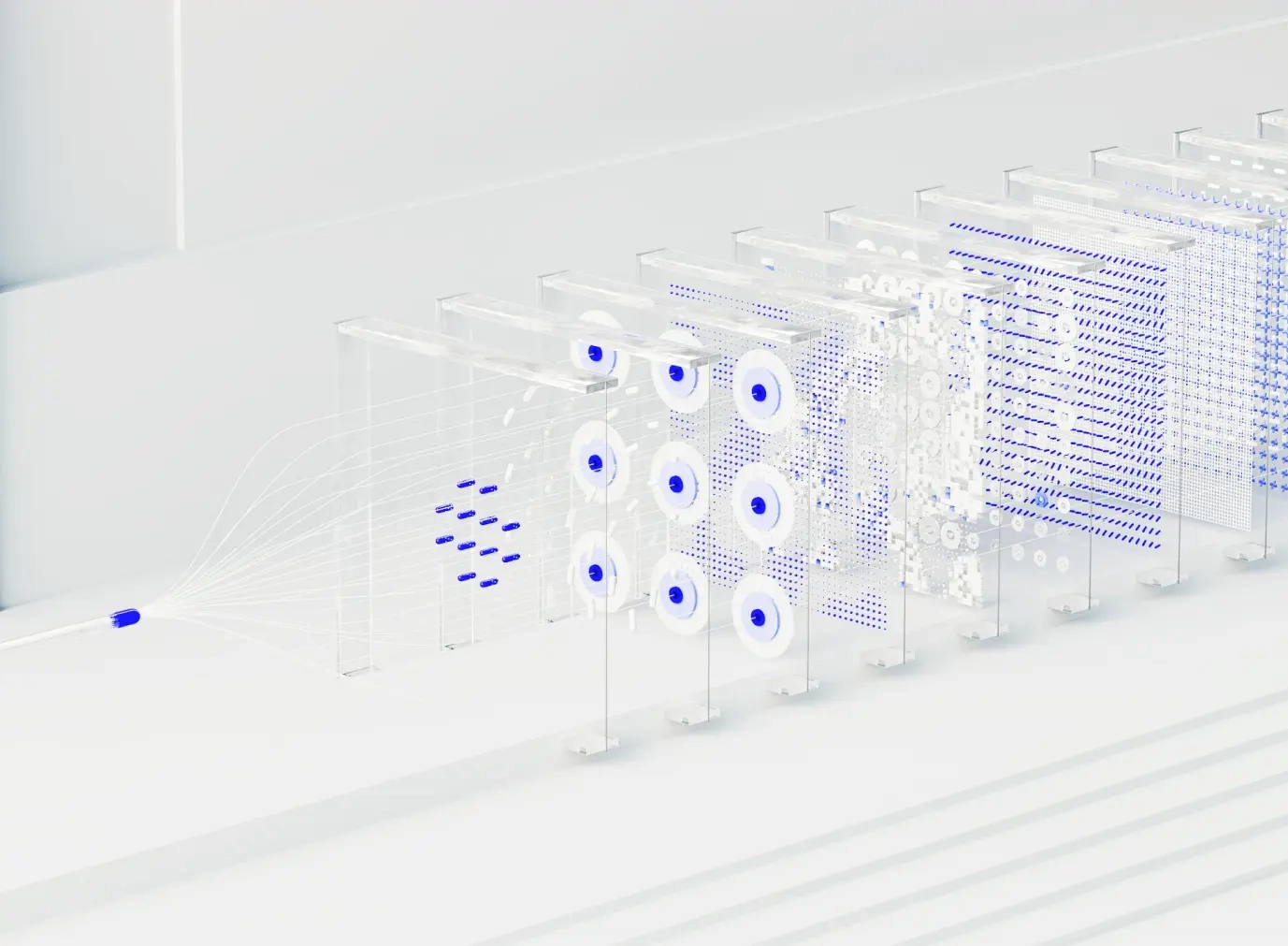
Individual agents work within the “data plane,” the operational layer where they perform tasks, retrieve information and interact with tools. The control plane sits above that activity as a centralized command center — determining how agents are deployed, how they communicate and which rules govern their behavior.
Its purpose is not the performance of a single agent, but the management of the larger system in which many agents, models, tools and data sources work together. As agents spread across departments, different teams build with different frameworks, connect to separate data sources and apply inconsistent rules — and fragmentation begins almost immediately.
Acting as an intermediary between agents and the systems they rely on, the control plane routes requests, verifies permissions and applies policies before an action is carried out. It also provides visibility into how agents behave in production — shifting the organization from operating agents as isolated software to managing them as a coordinated system.
Control Plane vs MCP
A Different Layer Than MCP
Although the two are often discussed together, an agent control plane and the Model Context Protocol operate at different layers.
In short: the control plane is concerned with how agents operate inside a broader environment. MCP is concerned with how a model receives the information and capabilities it needs to respond to a specific request.
Agent Control Plane
Governs systemwide coordination, orchestration, security and lifecycle management across agents, tools and services. It determines how agents are deployed, which systems they may use, how requests are routed, how actions are monitored and how policies are enforced across the broader environment.
Model Context Protocol (MCP)
Defines how tools, context and data are presented to a model during a particular interaction. It standardizes how a model receives information and connects to capabilities, but it does not by itself manage the larger operational system in which many agents are running.
Roles Across the Enterprise
Who Uses the Agent Control Plane
Different groups use the control plane for different purposes — together making it the foundation for operating AI agents in a structured, scalable way.
Developers
Create, test and improve agent workflows: define how agents interact, which tools they may call and how new versions perform before release.Platform & Infrastructure Teams
Manage computing resources, establish technical standards and create a common operating environment for agents built across the organization.Security & Governance Teams
Apply authentication, authorization, access controls and policy enforcement across agents and connected systems.Business & Operations Teams
Support compliance, oversight, accountability and reliable execution across workflows that span several departments.
Enterprise Agent Adoption
The Most Common Challenges
Organizations are moving from isolated AI assistants toward networks of agents that perform multistep work across systems and departments.
When work is divided among groups of agents — one retrieving information, another analyzing it, a third acting in a business system and a fourth validating the result — the absence of a control plane means gaining automation while losing visibility into how it behaves.
96%
of enterprises say they are already using AI agents in some capacity, according to the IBM Institute for Business Value.
94%
say AI sprawl is increasing security risks and operational complexity across the enterprise.
Fragmentation and Siloed AI
Agents are often introduced separately within HR, finance, IT, sales and legal, yet most processes cross departmental boundaries. When the supporting agents operate in isolation, the organization automates individual steps without improving the process as a whole.Limited Coordination and Orchestration
As the number of agents grows, interactions become harder to manage. Without a coordinating layer, agents may duplicate work, produce conflicting outputs or invoke tools in the wrong order — creating inconsistent experiences for employees and customers.Weak Governance and Control
Without shared guardrails, an agent may reach inappropriate information, use an unapproved tool or take an unintended action. One allowed to read a customer record may not need permission to export it, change financial data or send it externally — distinctions that are hard to enforce without runtime controls.Inconsistent Policies Across Teams
When every team builds its own agent environment, policies get embedded directly into individual applications. One group requires human approval, another allows the action automatically, a third has no formal process — leaving rules that are difficult to audit and maintain.Limited Visibility Into Production Behavior
Organizations may know an agent is running without knowing what it is doing — which tools were called, which data was accessed or where a workflow failed. Without logs, metrics and traces, teams reconstruct events only after something goes wrong.Uncontrolled Agent Sprawl
Without a central registry or onboarding process, agents multiply quickly. Teams build similar agents, buy overlapping tools and connect separate systems to the same data — increasing cost and duplication and making it hard to tell which assets are approved or still in use.

The Cost of Fragmentation
Why Addressing These Challenges Matters
Failing to address these challenges can have consequences that extend well beyond the performance of an individual AI application.
Security Exposure
Agents interact with sensitive systems at machine speed. If permissions are too broad or policies are not enforced during execution, a small configuration error can affect large volumes of information or transactions.
Operational Complexity
As agents, models and tools multiply, teams manage more dependencies, integrations and points of failure. Without a common operating model, each new use case adds complexity instead of reusing shared infrastructure.
Inconsistent Experiences
When agents follow different standards, users receive different answers depending on the interface, department or workflow they encounter. A coordinated system keeps behavior consistent.
Compliance and Audit Risk
Regulated organizations must show not only that a policy exists, but that it was applied to a specific action. Without centralized controls and audit trails, producing that evidence becomes difficult.
Slower Enterprise Adoption
Fragmented environments are harder to scale. Teams spend time rebuilding integrations and adding governance after deployment, slowing adoption and increasing pressure for vendor consolidation.
A Shared Control Layer
Our Approach: Core Capabilities
Rather than embedding every policy, permission and operating rule inside each agent, the control plane creates a common layer for coordination and oversight.
It does not replace the agents themselves. It provides the system around them — the routing, security, orchestration, observability and lifecycle controls required to operate them reliably.
1. Access Control
Authenticates and authorizes agents and users before they touch systems or data, applying least privilege so each agent gets only the access a task requires. Decisions can change dynamically — an agent may read a record when assisting an authorized employee but be blocked from exporting or sharing it.
2. Agent and Tool Registry
A centralized catalog of the agents, tools, services and models available across the organization, making them easy to discover, reuse and invoke consistently. It answers the basic questions: which agents are active, who owns them, what they can use and which version is deployed.
3. Execution Management
Governs what happens when an agent acts or calls a tool — handling inputs, outputs, failures, retries and exceptions at runtime. It validates inputs and outputs before they move on, so malformed or unsafe information does not propagate through a workflow.
4. Lifecycle Management
Supports agents from design through development, testing, deployment, operation and retirement, with version control, release management and audit trails. Teams can test a new version, compare it with the current one, release it to a limited group and expand only after it meets safety standards.
5. Policy Enforcement
Applies the rules that govern agent behavior — which tools and data are allowed, which actions are permitted and when human approval is required. Policies are evaluated during execution, not merely documented, so the control plane can block behavior that violates the rules as it occurs.
6. Request Routing
Directs each request to the appropriate agent, tool or workflow based on context, intent, capability, priority, availability or cost. A simple request goes to a lightweight model; a complex analysis to a specialized agent; a sensitive request into a workflow with human review.
7. State and Context Management
Determines how agents store, retrieve and share information across tasks, conversations and workflows — from temporary working context to state that persists across sessions. It governs where sensitive context lives, how long it is retained and which agents can retrieve it, preventing loss in multi-agent work.
8. Telemetry and Observability
Captures the logs, metrics and traces needed to understand how the system behaves — performance, usage, errors, decisions and outcomes. Teams can trace a request end-to-end and measure completion rates, latency, cost, policy violations and business value.
Platform Components
The Technical Foundation
Those capabilities are delivered through a set of platform components that determine how agents are created, deployed and operated at scale — the control plane coordinates and governs execution, while the underlying runtime performs the work.
The system receives and interprets requests, then coordinates their execution across agents, models and external tools — often through APIs, event-driven architectures and workflow engines that manage multistep processes, dependencies and branching decisions. A workflow may wait for one agent to finish before another begins, run several tasks in parallel, pause for human approval or reroute when a service is unavailable.
A controlled environment in which agents perform actions and interact with external services, including standardized interfaces, input and output validation, error handling and retries. Tool access is not a simple connection: the control plane determines whether the agent may use the tool, whether the request is valid, whether the output should be trusted and whether the action should be logged or reviewed — especially when tools can change records, move money or trigger communications.
A unified gateway that gives agents a consistent way to connect to data, applications, tools and outside systems. Instead of each agent maintaining separate connections to every service, the control plane provides a managed access layer with common security, observability and policy enforcement — reducing duplication and making integrations easier to maintain.
Every interaction among agents, users and systems is authenticated and authorized, typically through enterprise identity systems, access tokens and permissions that change dynamically with the user, task, data and context. Security extends beyond login: each important action is evaluated throughout the workflow, so a user may request information but not modify it, or an agent may use one tool but not another.
Agents need context to behave coherently over time, so the system supports short-term working context and longer-lived state through session stores, memory systems, vector databases, event histories and enterprise data repositories. The control plane determines how those sources are accessed and governed.
A clear view of what is happening in the system through logs, performance metrics and distributed traces, plus tools that make the information useful for monitoring, debugging and analysis. Traditional software monitoring is necessary but not sufficient — organizations also evaluate the quality of reasoning, the appropriateness of tool selection, the accuracy of outputs and the business consequences of decisions.
Policies are evaluated and enforced while agents operate, not left as static documents. Runtime enforcement checks proposed actions against defined rules and prevents violations — blocking an action, reducing the data returned, requiring additional authentication, routing for human approval or substituting a safer tool.
Support for the entire agent lifecycle — design, development, testing, release, operation and monitoring — with versioning and controlled deployment so improvements do not destabilize systems already in use. Organizations can compare versions, roll back changes and preserve a record of the instructions, models, tools and policies tied to each release.
The control plane keeps functioning as demand grows and when parts of the system fail, using distributed architecture, workload management, redundancy and graceful recovery. A production control plane manages bursts of requests, routes around failures and prevents a problem in one workflow from disrupting the broader environment.
An authoritative record of agents, tools, models and dependencies that helps teams discover and reuse existing assets and avoid rebuilding the same capabilities in different parts of the organization. It also supports security and governance by establishing ownership, approval status and permitted uses.
In Practice
Primary's Control Plane in Action
Continuous Improvement
Collect performance data and refine the system over time. When a support agent repeatedly escalates a category of issue, the control plane can detect the pattern and update routing to a better-suited agent — without teams redesigning every workflow.Customer Support Operations
Route requests among specialized agents, apply response standards and track performance across channels. A billing dispute goes to a billing agent with access limited to the relevant account; refunds above a threshold pause for human approval.Enterprise Workflow Automation
Coordinate multistep processes across CRM, ERP and internal apps. In procurement, one agent collects estimates, another compares terms and a third submits for approval — each step sequenced, compliant and recorded for audit.Governance and Compliance Enforcement
Keep agent behavior aligned with policy and regulation. In financial services, an agent producing investment recommendations follows suitability, disclosure and record-keeping rules, with outputs logged for regulatory review.Multi-Agent Collaboration
Divide a shared assignment across agents and combine their outputs. In a research workflow, one agent gathers information, another summarizes and a third prepares the report — with the control plane managing data transfer and quality checks.Tool and API Orchestration
Govern which tools and APIs can be used, in what order and under what conditions. A sales agent updates a CRM record, confirms the save, then triggers a follow-up email — each step governed by company rules.Financial and Operational Workflows
Coordinate agents across budgeting, forecasting, expense and invoice processing. One agent extracts invoice data, another matches it to a purchase order and a third prepares the transaction — with approved systems and a record of every decision.Software Development and IT Operations
Manage agents that write code, review changes or investigate incidents. An agent may diagnose a production issue and recommend a change while being prevented from deploying it without authorization.
Why It Matters
Benefits of an Agent Control Plane
The value of a control plane lies in improving how agents are governed, coordinated and observed in production — particularly for companies operating agentic systems at enterprise scale.
Centralized Governance
Define and enforce policies through a common system rather than embedding them in every agent. When a policy changes, you update the control layer instead of modifying every agent.
Clear Accountability
Trace actions to specific agents, tools, users and workflows — which agent acted, which version was running, what information it used and which policies applied.
Consistent Behavior
Shared rules reduce variation in how agents handle similar tasks, improving reliability and making performance easier to evaluate across departments and channels.
Continuous Adaptation
Monitoring, evaluation and feedback let the system refine routing and behavior as conditions change, surfacing recurring failures and inefficient paths.
More Efficient Use of Resources
Direct requests to the right agent, model or tool — reserving powerful models for tasks that truly need them and using simpler systems for routine work.
Faster Iteration
Test, approve and deploy updated agents through controlled processes, with versioning, staged releases and rollback making experimentation safer.
Improved Visibility
See what agents are doing, how they perform and where failures occur — helping teams resolve problems and executives evaluate return on investment.
Safer Operation
Access controls, validation and policy enforcement limit what agents can do and introduce human review for high-risk or ambiguous situations.
Scalability
As agents grow in number, a common operating model prevents fragmentation, duplication and loss of control — new agents are registered, governed and monitored consistently.
Implementation Guidance
When you unbox Primary...
Define policies for access, data use, approvals and accountability before agents are widely deployed. Adding controls after a system has expanded is typically more difficult and costly, and early governance gives development teams clearer expectations.
High-risk, unclear or consequential decisions may require human review. Build escalation and approval mechanisms into the workflow so people can intervene when automated judgment is not sufficient — rather than adding oversight only after a failure occurs.
Build logging, tracing and performance measurement into agent activity from the beginning, making it easier to diagnose failures, evaluate quality and understand behavior under real-world conditions — and to measure whether agents improve productivity and outcomes.
Apply authentication, authorization and validation throughout the workflow, not only at the outer boundary. Each agent, tool call and data exchange is a potential control point, and security should follow the action from the original request through every system involved.
Bring agents and tools into the system through a consistent registration process that improves discoverability, simplifies integration and reduces the risk of unapproved assets operating outside governance. Registration should include ownership, purpose, dependencies, permissions and lifecycle status.
Use system data, performance results and user feedback to improve routing, policies and agent behavior. A control plane should not merely enforce a fixed design — it should provide the information and mechanisms for the system to learn and improve over time.
The Agentic Enterprise
A Foundation for the Agentic Enterprise
An agent control plane provides the structure required to move from scattered AI experiments to coordinated enterprise systems.
It creates a common layer for deploying agents, routing work, controlling access, enforcing policy and monitoring behavior — the place where growing complexity can be made visible and manageable.
It lets organizations coordinate agents without forcing every one into the same framework, gives security and governance teams a shared point of control, gives developers a safer path to deployment and gives business teams confidence that automated work follows defined rules.
Most important, it allows agents to operate as a system rather than a collection of isolated components — the shift that will determine which organizations can scale agentic AI successfully.
Build Your Agent Control Plane
Coordinate, govern and observe every agent across your enterprise from a single control layer.